
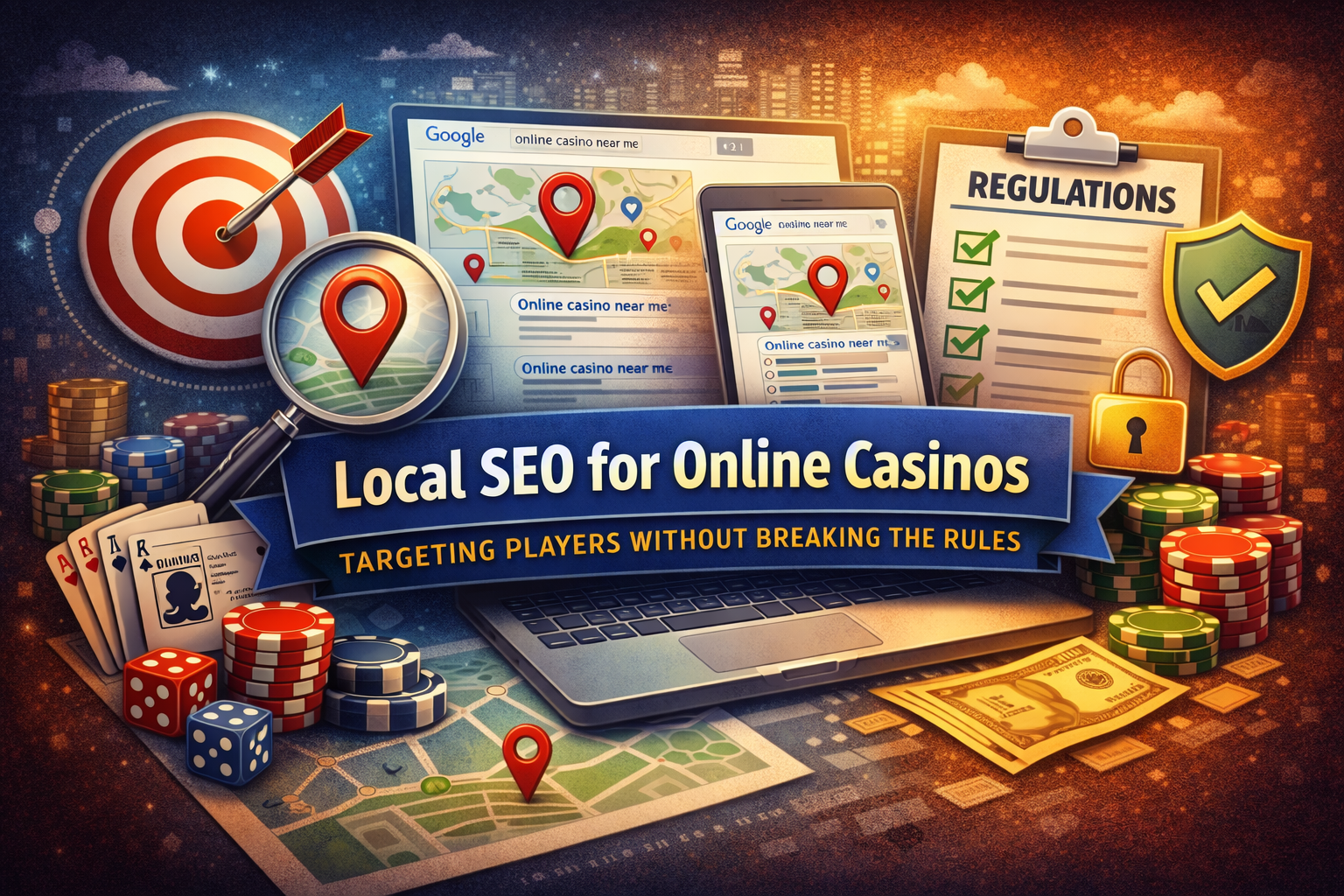
Local SEO for online casinos is basically the art of showing up in the right places for the right people—without stepping over legal or platform lines. That sounds simple until you remember that iGaming isn’t a normal “local business” category. A casino can’t just target every city it wants. Licensing boundaries, advertising rules, age-gating expectations, and search-engine policies all change depending on the jurisdiction. Done well, local SEO can drive sustainable growth. Done carelessly, it can trigger compliance issues, ad account problems, or even search visibility losses.
As Search Engine Journal’s comprehensive guide on local SEO points out, location-based optimization has become essential for businesses that compete in specific markets. The same logic applies to regulated gambling—only with higher stakes, because you’re optimizing inside a legal framework, not just a competitive one.
Understanding Local SEO in the Online Casino Context
Local SEO looks different for iGaming platforms because “local” is not just a marketing choice—it’s a compliance constraint. Operators have to balance visibility with the reality that the same page, offer, or claim can be acceptable in one region and risky in another. That’s why a smart strategy starts with jurisdiction boundaries first, and keyword opportunities second.
What Local SEO Means for Gambling Websites
For gambling websites, local SEO means aligning your site with how players in a licensed territory actually search—and making it clear (to users and to search engines) that you’re operating within legal limits. It’s less about pretending you’re a storefront and more about proving regional relevance: currency, payment methods, support resources, licensing details, and content that matches what’s permitted in that market.
In practice, the local SEO toolkit usually includes:
- Geo-specific keyword integration targeting city, state, or country-level search queries
- Localized content creation addressing regional payment methods, currencies, and gaming preferences
- Regional licensing information displayed prominently to establish legitimacy
- Location-based landing pages optimized for specific jurisdictions
- Local citation building through compliant directory listings
- Regional backlink acquisition from territory-specific authority sites
- Hreflang implementation for multi-language, multi-region content delivery
- Local schema markup signaling geographic relevance to search engines
How Regulations Shape Local SEO Strategy
Regulatory compliance isn’t something you “add later” in casino SEO—it shapes what’s allowed from the start. Jurisdictions often dictate how you describe bonuses, what you must disclose, which claims you can’t make, and what kind of responsible gambling information needs to be visible. That means local SEO isn’t just about ranking pages. It’s about building pages that can rank without creating problems.
| Compliant Practice | Non-Compliant Practice |
|---|---|
| Displaying active license numbers prominently | Making unverified regulatory claims |
| Using geo-restricted content for licensed regions only | Targeting players in prohibited jurisdictions |
| Including responsible gambling resources on local pages | Promoting aggressive bonus claims without terms |
| Implementing age-gate verification systems | Allowing unrestricted access regardless of location |
| Creating factual, informative regional content | Using misleading or exaggerated marketing language |
Core Local SEO Components for Online Casino Sites

To build strong local search visibility, casino sites typically need several pieces working together: content, technical signals, off-page trust, and clean compliance. The important part is consistency. A site that looks “regional” in keywords but not in licensing clarity (or vice versa) can confuse both users and search engines.
Geo-Targeted Keyword Research and Implementation
Location-based keywords help you reach players who are actively searching for legal options in a specific region. But in iGaming, keyword research isn’t only about volume and difficulty. It’s also about feasibility: can you serve that jurisdiction legally, and can you present content in a way that fits local requirements?
Common keyword formats in regulated markets include:
- “[state/province] online casino licensed”
- “best legal casino sites in [city/region]”
- “[country] licensed gambling platforms”
- “online slots [state] regulated”
- “legal poker sites [jurisdiction]”
- “[region] casino payment methods”
Location-Specific Landing Pages and Content
Dedicated regional landing pages are where local SEO usually pays off—if they’re done with care. A strong location page doesn’t just swap a city name into a template. It explains what matters for that jurisdiction: the legal landscape, what the operator is licensed for, which payment methods are actually relevant, and where players can find responsible gambling support.
High-quality location pages typically include:
- Clear licensing and regulatory compliance statements
- Regional payment options and currency support details
- Localized game portfolios reflecting regional preferences
- User testimonials from verified players in that jurisdiction
- Links to local responsible gambling organizations
- Region-specific promotional terms and conditions
The goal is simple: make the page genuinely useful for someone searching from that region, while keeping everything consistent with what the operator can legally offer.
Local Listings and Citations: Building Trust Without Violating Rules
Local citations and directory presence can still be useful trust signals in gambling SEO, but they require more selectivity than in most industries. You’re not trying to appear everywhere—you’re trying to appear in the right places, with correct information, and without creating “promotion” issues in restricted markets.
Optimizing Online Profiles and Local Directories
Consistency matters. Where listings are appropriate, keeping business information aligned across directories can reinforce legitimacy. For casinos, this often means choosing platforms that allow licensed gambling listings and ensuring details remain accurate and uniform where applicable.
Responsible Inclusion in Local Guides and Directories
Operators can build local visibility by participating in guides that focus on compliant, jurisdiction-specific information. The key is being intentional: pick directories that are clearly aligned with licensed gambling information and avoid placements that feel like broad, uncontrolled advertising.
For example, when building presence in regional guides, operators may focus on resources such as thepokies 114 net australia, which provides jurisdiction-specific casino resources for Australian players seeking compliant gaming options.
And as Moz’s comprehensive local SEO resource explains, citation consistency and quality directory selection remain foundational to establishing local authority—especially when you’re trying to build trust signals, not just links.
Reviews, Reputation, and Community Signals

Player reviews and community signals influence how people feel about a casino before they ever register—and they can also support credibility in local markets. For casinos, the value isn’t only “more reviews.” It’s relevant reviews that reflect real experiences in the jurisdiction you’re targeting and reinforce trust without drifting into promotional language that regulators dislike.
Encouraging and Managing Player Reviews
Collecting genuine player feedback needs a careful approach. The safest long-term strategy is focusing on authenticity and verification, not hype. These methods can generate location-specific reviews while staying on the ethical side:
- Post-withdrawal review requests sent after successful cash-outs to verified players
- Email campaigns targeting engaged players in specific licensed jurisdictions
- On-site feedback prompts appearing after positive gaming sessions
- Loyalty program incentives offering bonus credits for honest platform reviews
- Regional satisfaction surveys gathering jurisdiction-specific feedback
- Social media engagement encouraging players to share experiences organically
Responding to Feedback and Building Credibility
How you respond matters as much as the review itself. Thoughtful, professional replies show that the operator takes concerns seriously and maintains active engagement. It’s also a chance to reinforce practical compliance messages (like verification steps or responsible gambling links) in a natural, non-salesy way. Over time, that consistency helps build trust with users and strengthens the brand’s perceived reliability in the target region.
Technical and On-Page SEO Best Practices for Local Visibility
Technical optimization is what makes local signals “stick.” If regional pages are slow, confusing on mobile, or inconsistently served to users and bots, the strategy becomes fragile. A clean technical base helps search engines understand where you operate and helps players actually use the site without friction.
Mobile Optimization and Page Performance
Mobile responsiveness is especially important because most local-intent searches happen on smartphones. Players searching on the go expect pages to load fast and to navigate cleanly—especially when they’re comparing options side by side.
Practical mobile checkpoints for casino sites include:
- Page load times under 3 seconds on 4G connections
- Touch-friendly navigation and button sizing
- Responsive design adapting to all screen dimensions
- Accelerated Mobile Pages (AMP) implementation where appropriate
- Mobile-first indexing compatibility verification
- Compressed images and optimized multimedia content
Schema Markup and Local Signals
Structured data markup can help search engines interpret business attributes and regional relevance more clearly. Using organization and local-related schema (where appropriate), plus geo-specific structured elements, can support clearer signals about licensing jurisdictions and service availability—especially on pages built for specific regions.
Compliance-Centric Content and SEO Risk Management
If there’s one thing that separates casino local SEO from standard local SEO, it’s the constant need to evaluate risk. “Aggressive” tactics that might work in other industries can backfire quickly here. Each page needs to fit within both search engine guidelines and the advertising rules of the jurisdiction it targets.
Staying Within Advertising and Content Rules
Compliant local content requires discipline. A line that sounds harmless in one market can be unacceptable in another, especially around bonuses, claims, and audience targeting. That’s why content review needs to be region-aware, not generic.
Content practices to avoid:
- Exaggerated winning claims or guaranteed return statements
- Bonus promotions without complete terms disclosure
- Targeting minors through inappropriate imagery or language
- Making medical or financial benefit claims about gambling
- Using aggressive or misleading call-to-action language
- Promoting irresponsible gambling behavior or excessive play
Geo-Targeting and Content Exclusion Best Practices
Geographic content restrictions help ensure players in prohibited jurisdictions do not access marketing materials or services that aren’t meant for them. In practice, this often involves a blend of IP detection, geo-redirects, and hreflang tags so the right content is shown to the right users, and restricted regions are handled appropriately.
Measuring Local SEO Success and Adjusting Strategy
Local SEO isn’t “set and forget,” especially in iGaming. Tracking region-specific performance lets operators spot what’s working, what’s slipping, and where compliance or market shifts require quick changes. Good measurement also prevents wasted effort—because not every region will respond the same way.
Local Ranking Metrics and Analytics Tools
Useful indicators for local SEO performance include:
- Local search ranking positions for geo-targeted keywords
- Organic traffic volume from specific geographic regions
- Local pack visibility and map ranking performance
- Click-through rates on location-specific landing pages
- Conversion rates by geographic segment
- Regional backlink acquisition and citation growth
- Mobile traffic and engagement metrics by location
Common tool choices include Google Search Console with location filters, Google Analytics with geographic segmentation, local rank tracking tools (BrightLocal, Whitespark), and heatmap analysis software.
Adapting to Regulatory and Market Changes
Continuous monitoring of legislation and search engine policy updates is part of operating in a regulated industry. The safest approach is building alerts and internal processes around change: watch target markets for new rules, monitor platform policies for updates, and keep local pages easy to review and adjust when requirements shift.
Conclusion
Effective local SEO for online casinos is a balancing act: traditional optimization principles on one side, gambling-specific compliance on the other. Operators who succeed tend to do the basics exceptionally well—geo-intent keyword targeting, location pages that are genuinely useful, careful directory selection, strong technical foundations—while keeping every market’s regulatory framework front and center.
When local SEO is treated as “compliance-first,” it stops being a gamble. It becomes a repeatable way to build authority and trust in licensed regions, without risking penalties, policy violations, or brand damage. In iGaming, that’s not just safer—it’s usually the only path to sustainable regional growth.