The garage door is down, the Edison bulbs are on, and someone got there early to set up the card table and sort the chips into four stacks. A shuffled playlist — Sinatra into Herb Alpert into something from a ’60s lounge compilation — is already going at the right volume. Your neighbor shows up with a bowl of pretzels. Your brother-in-law arrives with a six-pack and no particular agenda. Nobody drove anywhere. Nobody put on shoes they had to think about. The night has zero stakes and somehow that makes it feel better than most nights out.
That’s the specific thing a retro garage game room does well. It’s not just a space — it’s a frame. The slightly-removed-from-the-house quality, the low lighting, the aesthetic borrowed from a mid-century rec room or a Vegas lounge circa 1962, it all signals to people: relax, nothing here is precious. Nostalgia is relaxing in a way that’s hard to manufacture. When the room looks like it belongs to a different decade, people stop worrying about it and start actually hanging out.
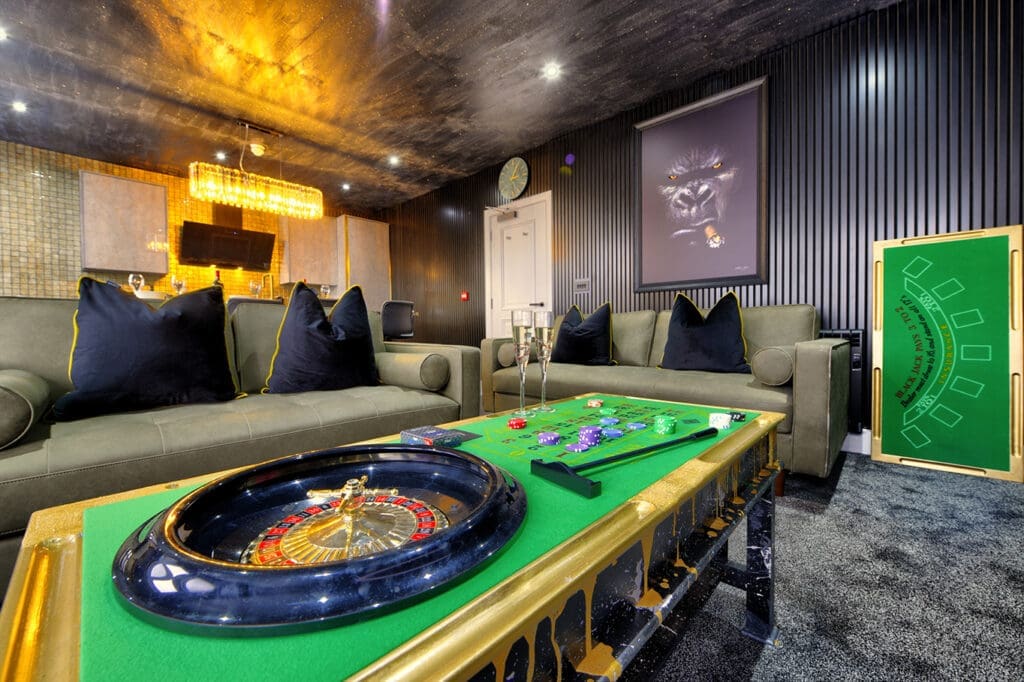
Worth saying clearly upfront: this isn’t about building a real casino. The poker chips are for scoring. The roulette wheel is a prop. Whatever’s on the cocktail tray is whatever people felt like drinking. The room should work for a 14-year-old and a 70-year-old on the same Friday night, because in most families that’s exactly who ends up there.
When people start putting together a setup like this, a lot of the early planning happens online — browsing for visual references, trying to translate a vague feeling into actual colors and objects. One home hobbyist mentioned stumbling across jackpot-jill.com while hunting for retro casino aesthetics — the kind of reference that helps answer questions like what shade of green the felt should be, or what a vintage lounge sign actually looked like. That research step, however informal, saves money later by narrowing choices before anything gets purchased.
What follows is a practical guide through the whole setup: the garage itself, the mood, the layout, the furniture, the lighting, the games, the snacks. No hype about “transforming your space.” Just the stuff that actually determines whether the room gets used once or every weekend.
The best versions of these rooms are rarely the most expensive ones. A thrifted bar stool under a warm lamp reads better than a catalog piece under a fluorescent tube. Atmosphere does more work than money does, and that’s genuinely good news.
Start With the Garage Itself
No vintage poster is going to fix a room that’s 45 degrees in November. Before anything decorative happens, the garage needs to work as a room — and most unfinished garages have a short list of problems that kill the vibe regardless of how good the décor is: cold floors, no temperature control, not enough outlets, and an echo that makes every conversation sound like it’s happening inside a shipping container. Deal with these first.
Flooring is usually the most impactful single upgrade. Bare concrete is miserable to stand on after about an hour — it’s cold underfoot even when the room is warm, and it’s unforgiving on legs and backs during a long game. Interlocking foam tiles are cheap and work fine. Peel-and-stick vinyl plank costs more but genuinely transforms the space. For the retro look, black-and-white checkerboard vinyl is almost absurdly on-theme and still affordable at most home improvement stores.
Electrical is worth thinking about before the first extension cord gets run. A single outlet powering a mini-fridge, space heater, speaker, and string lights is a fire waiting to happen. Having a licensed electrician add a dedicated circuit is relatively inexpensive and worth it. The Electrical Safety Foundation International has a useful rundown of garage-specific electrical safety that’s worth reading before any wiring work starts.
- Aim for at least 4–6 accessible outlets around the room — more than you think you’ll need
- Add a dedicated circuit if running a mini-fridge, space heater, or multiple light setups simultaneously
- Insulate at least one wall or the garage door itself if the winters are serious
- Get a ceiling fan or portable AC unit sorted before summer — heat kills game nights faster than anything
- Put an area rug or rubber mat over the concrete, even a cheap one; the difference is noticeable immediately
- Hang acoustic foam or heavy curtains to cut the echo — a hard-walled garage is a sound disaster
- Move stored items into labeled bins along one wall so they don’t drift into the play area over time
- Add a second overhead light or a couple of lamps — garage lighting is almost always too dim and too harsh
- Put a coat hook and a small table near the door so guests aren’t hovering with their stuff in their arms
- Pre-heat or pre-cool the space 20–30 minutes before guests arrive; garages take longer than rooms do
Choose the Mood
Picking one clear direction makes every other decision easier — colors, furniture, lighting, art, all of it. The most popular choice for this kind of room is the classic Vegas lounge, roughly 1955 to 1975: deep greens and burgundies, gold accents, low warm light, framed playing card art, and the general suggestion that Dean Martin might stop by later. It’s the easiest direction to shop for because the references are everywhere.
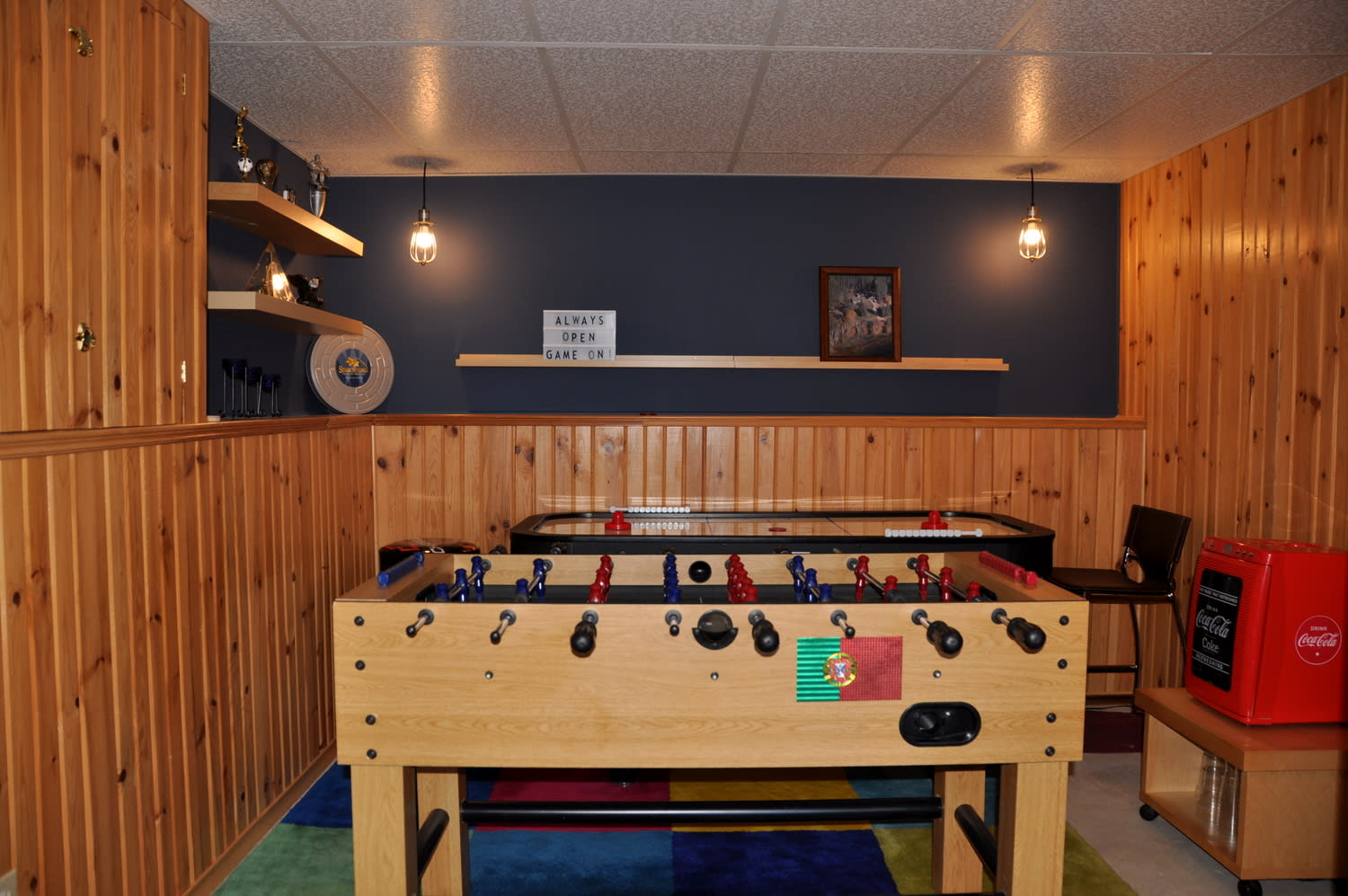
A 1970s rec room goes somewhere warmer and more chaotic — burnt oranges, browns, a little macramé, maybe a shag-textured rug. Think of the basement in every movie where a group of teenagers is playing Atari and someone’s dad has a wet bar in the corner. Less formal, easier for families with kids, and not specifically casino-coded, which can be a feature depending on the crowd.
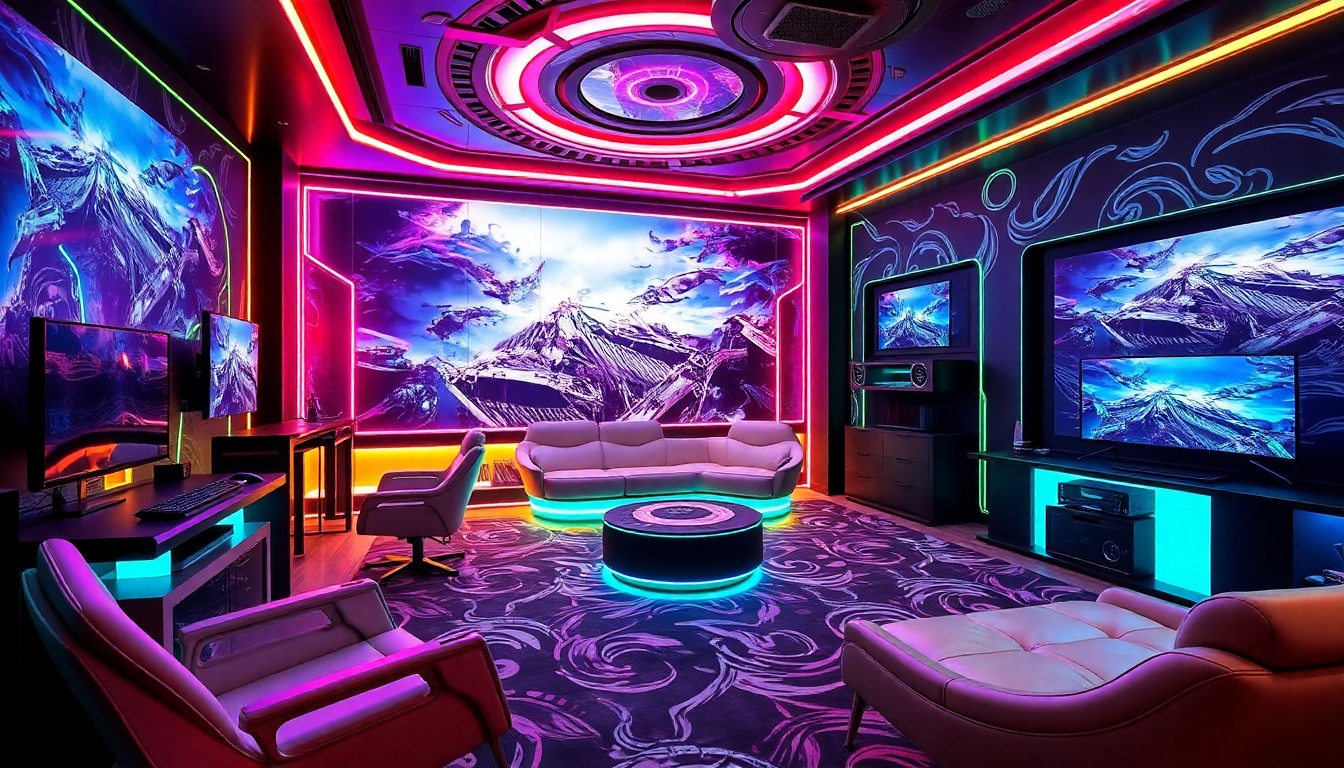
The neon arcade-casino hybrid is newer but works well with modern LED technology: black walls, pink and teal neon sign accents, black velvet felt, chrome stools. It runs retro and slightly futuristic at the same time. Whichever direction is chosen, the important thing is to actually commit to it. A room that’s half Vegas lounge and half coastal farmhouse ends up feeling like a waiting room.
Layout Matters
The most common layout problem in garage game rooms is that everything ends up clustered in one spot while the rest of the space does nothing. A good layout creates distinct zones — a main game area, a snack and drink station, and somewhere for the people who aren’t playing at that moment to sit without being underfoot. Three zones, even in a small garage, is the difference between a room and a crowd.
Keep walking paths clear. People move constantly in a game room — getting up for a drink, shifting to watch a hand, swapping seats between rounds. Thirty-six inches of clear floor between furniture pieces is the practical minimum to avoid a room that feels stuffed. The snack area tends to be the thing that gets squeezed into a corner and forgotten until people are knocking into it all night.
| Zone | Purpose | What to Include | Common Mistake |
|---|---|---|---|
| Main Game Area | Primary activity space | Card table, chairs, good overhead light, chip tray | Placing it too close to the door |
| Snack & Drink Station | Food and beverage access | Mini-fridge, rolling cart or shelf, coasters, trash can nearby | Forgetting the trash can — the mess ends up on the table |
| Lounge Seating | Watching, socializing, resting | Low chairs or a bench, small side table, soft lamp | Skipping it — spectators and non-players need somewhere to land |
| Game Storage | Keeping things organized | Shelves, labeled bins, a dedicated box for chips and cards | Keeping games in the house — if they’re not in the room, they don’t get played |
Tables, Seating, and Comfort
A dedicated card table is worth having. Basic folding tables from any big-box store run $50–$100 and do the job fine. An octagonal poker table with a felt top and built-in cup holders is a step up — people notice it the moment they walk in, and it anchors the whole room in a way a folding table doesn’t quite manage. Green felt says classic casino; burgundy or blue says modern card club; both work, just pick one and stay consistent.
Seating is where a lot of game rooms quietly fall apart. The chairs look fine but get uncomfortable after an hour, and once people start shifting around and stretching, the energy starts to leave the room. Hard wooden stools are the usual culprit. Padded bar stools, folding chairs with seat cushions, or even dining chairs pulled from inside make a real difference. Thrift stores almost always have padded bar stools in neutral colors for $10–$20 each — it’s genuinely one of the better uses of a small budget in this kind of room.
Don’t skip secondary seating. A loveseat, a couple of club chairs, or a long bench with cushions along one wall gives the room range. Not everybody wants to play every hand. Having somewhere comfortable to observe keeps those people in the room instead of drifting back inside. The neon sign gets the attention, but the extra cushion on the bench often gets used more.
Lighting That Makes the Room
Overhead fluorescent lighting is the single biggest enemy of atmosphere in a garage conversion. One warm incandescent lamp in the corner will do more for the room’s feel than almost any decorative object. The goal is layered light: something ambient up top, task light over the game table, and accent light from string lights, shelf strips, or a single LED sign. That combination — three sources at different heights — is what makes a space feel designed rather than just lit.
A dimmer switch is a small investment that pays off immediately. Being able to bring the overhead light down while the accent pieces stay on takes the room from functional to actually atmospheric. Warm white bulbs in the 2700K range are the right call throughout — anything cooler reads as office, not lounge.
| Lighting Type | Mood Effect | Best Use | What to Avoid |
|---|---|---|---|
| Warm Edison string lights | Cozy, festive, nostalgic | Along rafters or walls as ambient fill | Too many strands — it tips from cozy into cluttered |
| Adjustable pendant lamp | Focused, classic | Directly over the card table | Glare angled into players’ eyes — height and position matter |
| LED neon sign | Retro energy, visual anchor | Feature wall accent — one custom phrase or playing card symbol | More than one or two; they compete and cancel each other out |
| Under-shelf LED strips | Warm glow, depth | Below shelves, behind a bar cart, under a countertop | Bright white strips — always use warm white (2700K) |
Retro Details That Sell the Theme
The details are what make a generic garage into a room with a personality. Most of them cost almost nothing. A thrift-store tray holds the chip stacks. A free public domain illustration in a six-dollar frame becomes a vintage casino sign. Soft lighting makes cheap décor look considered. The difference between a room that feels designed and one that feels decorated is usually just consistency — everything pointing in the same direction, nothing fighting for attention.
Vintage playing card art is freely available, printable, and endlessly useful. Download high-resolution public domain card illustrations, print them large at a copy shop for a few dollars each, frame four of them in matching frames, and hang them as a grid. That’s a real statement wall for under $30. Add a chalkboard for scorekeeping and a single analog clock with a simple face — not a novelty design — and the room starts to look intentional rather than assembled.
- Framed vintage card room rules (“Aces wild,” “No phones at the table,” “Dealer calls the game”)
- A simple analog clock — round face, no novelty elements, hung at eye level
- A small vintage radio on a shelf, working or purely decorative
- A weighted poker chip set in a wood or aluminum case, left visible on or near the table
- A retro cocktail tray with matching lowball glasses — doesn’t need to be expensive
- Thrifted pendant lamps or sconces with warm Edison-style bulbs
- A chalkboard or small dry-erase board for score tracking
- One piece of actual vintage casino ephemera — an old score card, a matchbook, a menu card behind glass
- A popcorn machine — functional and immediately signals “event”
- A custom LED neon sign with the room’s name or a simple phrase in the room’s accent color
Games That Work for Friends and Family
The games are the point. Everything else is just setup. For a mixed group — different ages, different competitive tolerances, maybe a couple of people who don’t know poker from pinochle — the best game nights rotate through a few options rather than locking into one game that runs until someone’s bored or frustrated.
Poker with chips-for-points works for nearly any age once someone explains the basics, and it fits the casino theme without any actual stakes. But having alternatives ready matters. A round of trivia or a fast dice game can reset the room’s energy mid-evening. Something low-pressure like Yahtzee or Rummy keeps things inclusive for guests who find poker stressful or unfamiliar. The bracket board on the wall — a simple printed sheet in a frame — turns a casual Yahtzee round into something people actually compete for.
- Texas Hold’em with chip scoring, no money involved
- Blackjack with a rotating dealer — surprisingly easy to run and genuinely fun
- A party roulette wheel for group rounds — low stakes, high noise
- Yahtzee tournament bracket, which is louder and more competitive than people expect
- Gin Rummy or Canasta for smaller groups or a quieter part of the night
- Trivia rounds between longer games to reset the energy
- Farkle or Bunco — fast to teach, fast to play, good for mixed groups
- A themed board game like Monopoly Casino Edition when people want something slower-paced
- Mini tournaments with a visible bracket so there’s something to follow across the whole evening
Food, Drinks, and Hosting Touches
A well-placed snack station does more for a game night than almost any piece of décor. The mini-fridge humming quietly in the corner is one of the best investments in the whole room — it keeps people from disappearing into the house every twenty minutes and not coming back for a hand. A rolling bar cart or a simple shelf with snacks, napkins, and a trash can nearby takes care of the rest. Everything should be reachable without getting up from the table, or at least without walking more than a few steps.
Finger foods are the right format. Things that don’t require plates, utensils, or much attention: pretzels, chips and dip, sliced cheese, deli meat, cookies, fresh popcorn. Mocktail options — sparkling water, juice, lemonade — make sure non-drinkers aren’t hunting around for something to reach for. Coasters on every surface means fewer conversations about drink rings on the felt.
The reset is as important as the setup. If cleaning up takes half an hour, the room gets used less — it’s that simple. A bin under the cart for trash, a designated corner where chairs stack, and a chip case that everything goes back into means the next session starts clean. Under ten minutes is the right target for end-of-night cleanup.
Sound and Atmosphere
Garages are acoustically unpleasant. Concrete floors, bare walls, a metal overhead door — every surface bounces sound, and the result is a room where conversation is harder and music sounds harsh and flat. Rugs, curtains, and upholstered furniture absorb some of that, but speaker placement is the thing most people get wrong. A single Bluetooth speaker aimed at a wall or tucked into a corner creates far more reflection than one sitting in the center of the room, angled toward the people in it.
The playlist, in a retro casino room, is part of the décor. The Rat Pack — Sinatra, Dean Martin, Sammy Davis Jr. — is the obvious anchor. A broader mid-century jazz and lounge mix keeps it from feeling like a tribute night. Volume is the thing to calibrate carefully: if people are raising their voices to talk across the card table, the music is too loud. This is a more common problem than it sounds, and one of the quieter reasons a game night ends earlier than it should.
Budget vs Splurge
Almost everything in a retro game room has a cheap version that works nearly as well as the expensive one. The places where it’s actually worth spending more are the card table, the seating, and the lighting — these three things affect how long people stay and how often the room gets used. Everything decorative can be thrifted, printed, or built for next to nothing without the atmosphere suffering at all.
| Item | Budget Option | Mid-Range Option | Worth the Spend? |
|---|---|---|---|
| Card table | $40–$60 folding table | $150–$300 octagonal poker table | Yes — anchors the whole room visually and functionally |
| Seating | Thrift store bar stools ($10–$20 each) | Padded folding chairs ($30–$50 each) | Yes — this is where comfort falls apart if skipped |
| Lighting | String lights + one floor lamp | Dimmable pendant + warm LED accent strips | Yes — highest atmosphere-per-dollar of anything in the room |
| Décor / Art | Printed and framed public domain images | Vintage finds from an antique market or estate sale | No — the budget version works just as well with good framing |
| Sound | Existing phone speaker | Mid-range Bluetooth speaker ($80–$150) | Modest spend is enough — don’t over-engineer the audio |
| Flooring | Interlocking foam tiles | Peel-and-stick vinyl plank | Yes — bare concrete undermines everything else in the room |
A Setup People Will Actually Use
A beautifully decorated game room that’s cold in February and takes twenty minutes to set up is a room that gets used three times and then sits empty. The rooms that become regular Friday night destinations are the ones where the barrier to getting started is almost zero. The table is already up, or it unfolds in two minutes. The chip case is always in the same spot. The space heater is plugged in and pointed the right direction. The snack shelf has something on it even on a Tuesday.
Flexibility matters more than people expect. A room that only works as a game room will spend a lot of time unused. The same space should be able to host a big-game watch party, a teenager’s hangout, a birthday gathering. Foldable tables and stackable chairs make that possible. The retro décor stays — it just changes context.
- Keep the chip set and card decks in a single labeled box, always in the same spot
- Put the main light on a smart bulb or dimmer so the setup mood takes one tap
- Keep a basic snack supply in the room year-round — even just crackers and a couple of drink options
- Clean up fully after every use; a messy room is hard to get enthusiastic about
- Start heating or cooling 30 minutes before guests arrive — garages don’t adjust quickly
- Rotate the games every few months so regular guests have something new to look forward to
- Keep a spare deck of cards in the room; worn decks shuffle badly and people notice
- Put a short cleanup checklist on the wall so the end of the night has a clear finish line
The best retro garage game rooms feel like they’ve always been there. The worn corner of the chip case, the particular creak of the bar stool closest to the lamp, the playlist that everyone in the group now privately thinks of as Friday-night music — none of that comes from a shopping cart. It comes from showing up, repeatedly, in a room that’s easy to be in.
Comfort, flow, and a genuine sense of personality will outlast any impulse purchase. The room doesn’t need to be finished or expensive. It needs to be easy to get into, warm when it’s supposed to be warm, and stocked with things that actually get touched.
Build it for the people who’ll fill it, and it’ll pay for itself the first night everyone stays two hours longer than they planned to.